I often think about what draws leaders and activists to advocate.
What is the reason some people dedicate their lives to ensuring that others’ voices are heard and their situations are improved?
Do the people engaging in this work simply possess an innate compulsion to do good?
What causes someone to fight for a better world — not just for themselves, but for everyone around them?
I ask myself why I do this work. Why do I seek to learn from others’ lived experiences? What drives me to be curious: to educate myself every day? And why do I channel my lived experiences into advocacy to try to make this world a more equitable, inclusive, and accessible place?
While there are undoubtedly many varied and complicated answers to these questions, I’m fairly confident that they share a common root: empathy.
Empathy, as defined by the Oxford English Dictionary, is “[t]he ability to understand and appreciate another person's feelings, experience, etc.” The capacity to use our lived experiences, values, and emotions to connect with others – to hold space for their joy, pain, anger, grief, and humanity – is what allows us to transcend our subjectivity, peer outside the walls of our skins, and recognize what is happening around us. Empathy is what compels us to share our boundaries, care for others in the ways they need, and lean into compassion and grace.
Overused yet underappreciated, empathy might just be our greatest superpower.
For without empathy, there is no advocacy. Actually, let me back up even further: without empathy, there is no ability to recognize the need for advocacy.
We cannot champion folks in spaces where they have been historically excluded if we cannot first put ourselves in their shoes, and recognize the impacts of personal circumstances, systems of oppression, and policies that impact their physical, mental, emotional, and spiritual health.
Empathy is what allows us to step outside our narrow understanding of the world, and find connection with people whose personal circumstances and lived experiences differ from our own.
While most of us understand empathy in an abstract sense, translating that into daily action is far more profound. Living in a way that is aligned with empathy compels us to confront difficult truths, challenge systems of injustice, and hold ourselves accountable to the impact we have on others. It’s understanding what space we take up and how we can make space for those who have been silenced or forced to the margins. It's not always comfortable, and it's rarely convenient.
Coming from a social work background, I do not view empathy as a passive quality. It is not merely a matter of being kind or understanding in the moment. Rather, it's a rigorous, active commitment to centring care and humanity in every interaction and decision. It calls on us to listen deeply, decentre our own assumptions, and consistently ask: Whose voice is missing? Who is being harmed? What more can I do to make space for others?
This kind of empathy requires us to step outside of performative gestures or surface-level compassion. It challenges us to live in integrity with our stated values — even when it's inconvenient, even when it costs us something. Whether it’s how we show up in our relationships, make choices as consumers, or advocate within our workplaces and schools, empathy pushes us beyond intention and into aligned action.
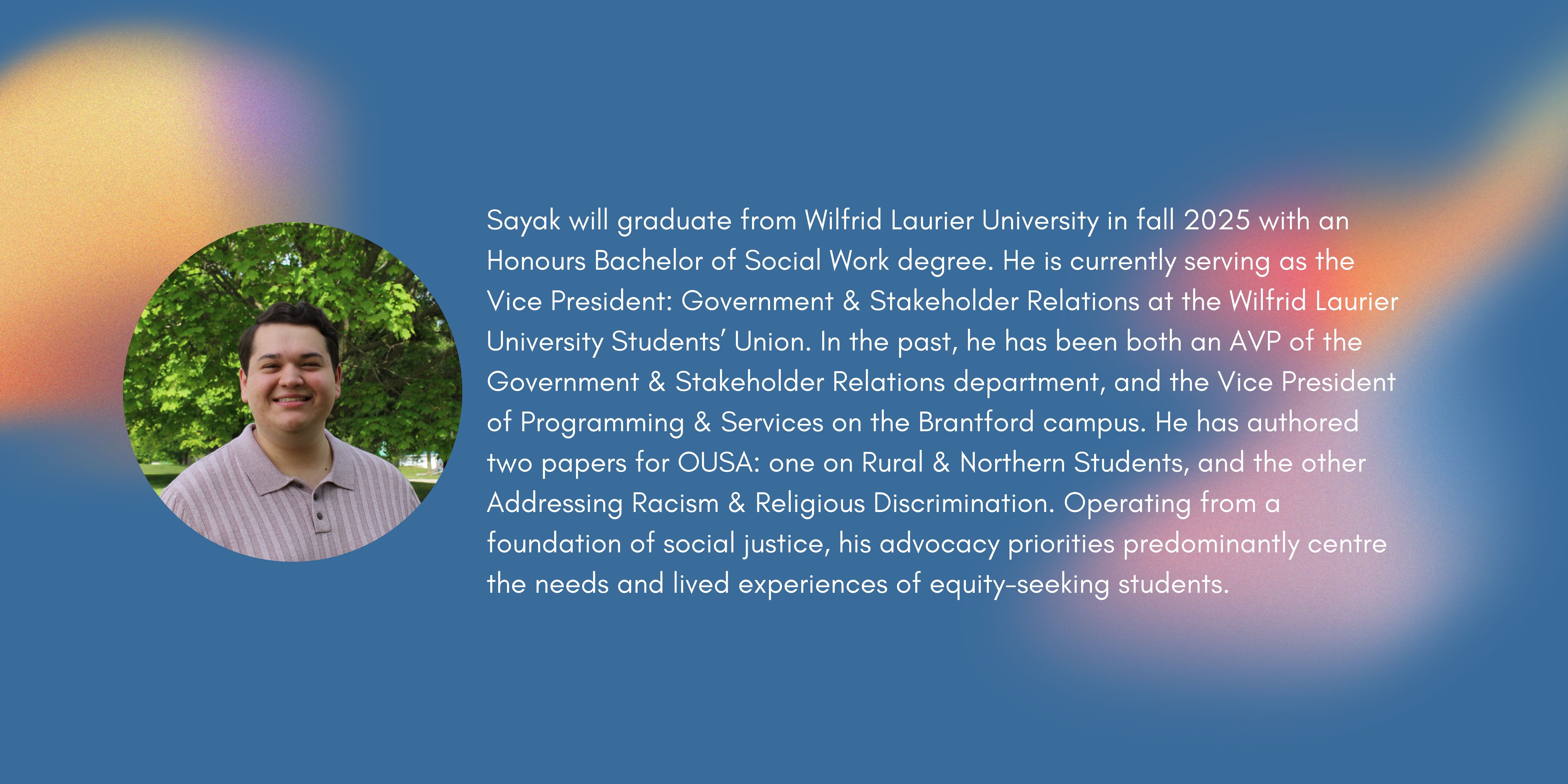
As OUSA President, empathy is the first, most fundamental job requirement because it gives me the impetus and drive to seek to understand Ontario’s diverse universities and their even more diverse students. To meet folks where they are, and be part of getting them where they need to be.
Throughout my educational journey in Wilfrid Laurier University’s Bachelor of Social Work program, I have recognized the benefits I reap from being cisgender, middle-class, white-passing, and a future social worker. My empathy has also helped me to see others who are excluded from those benefits because they possess different identities, and thus aren’t afforded the same privileges. At the same time, I carry lived experience shaped by my Queerness, disability, and racialization (I am half-Indian). These realities deepen my empathy and understanding of the violence that racialized, Queer, and disabled communities continue to face.
In a world where change is increasingly and alarmingly fuelled by hate — hate that is actively aimed at vulnerable groups for cheap political talking points, and hate that is infused into neglectful policy and blithe unconcern — it’s clear to me that we are in a crisis of empathy.
And this scares me.
Because even as we navigate a devastating period of social injustice, global violence, and economic crisis — one which has forced many of us into the lifeboat of self-preservation mode — I believe we cannot give up on empathy.
Why do we need to advocate for others?
Empathy. Because to give up on empathy — to not care for those who experience life differently from us, and who face different challenges — is to give up on our shared humanity. Empathy is how we fight for our liberation. Our liberation is interconnected; without freedom for all, there is no freedom for anyone.